
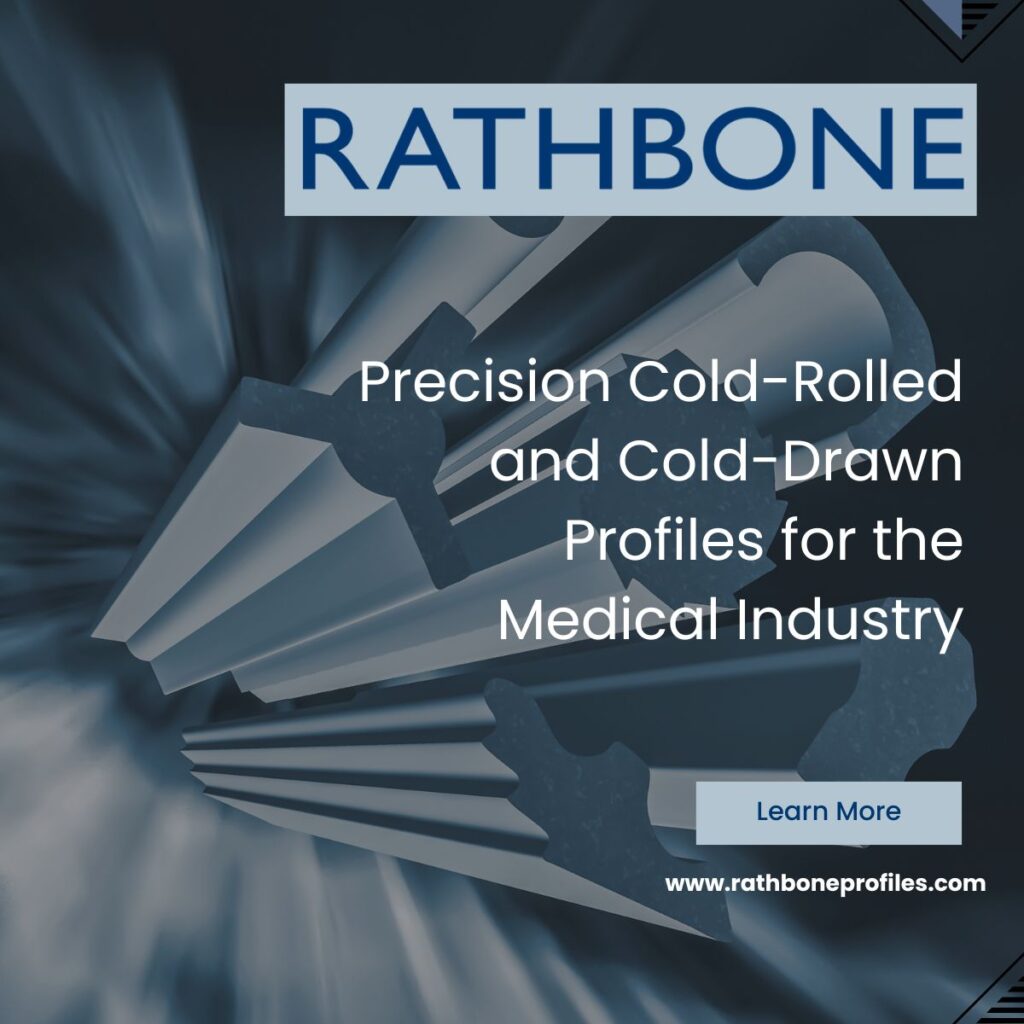
Rathbone Precision Metals manufactures precision cold-drawn and cold-rolled profiles in a wide range of materials, including alloy steels, carbon steels, stainless steels, nickel alloys, and bronze.
Our profiles are supplied in multiple forms to meet your specific requirements, including bars, cut-to-length pieces, catch-weight, and pancake-wound coils.
Using advanced processing techniques, we achieve exceptionally tight tolerances—often within thousandths of an inch—ensuring consistent quality and precision for demanding applications.
Why Use Stainless Steel for Medical Purposes?
Medical devices must meet stringent design and fabrication criteria which is why stainless steel is commonly used in the healthcare industry. Stainless steel has a non-porous surface, which means bacteria and viruses cannot soak into it. Other advantages of stainless steel include:
- Biocompatible
- Corrosion-resistance
- Durable
- High heat resistance
- Ease of sterilization
- Resistance to bacteria, viruses, and other microorganisms
- Availability in non-magnetic and magnetic varieties
Overview of Stainless Steel used in Medical Applications.
300 Series
The 300 series of stainless steels are austenitic and can only be hardened using cold working methods. 300 stainless steels are typically composed of 18% to 30% chromium and 6% to 20% nickel. This series of stainless steel is resistant to corrosion and maintains its strength at high temperatures and can withstand repeated sterilization processes, making them suitable for medical environments.
300 series stainless steels possess the following advantages:
- Widely available and can be used in numerous applications
- Developed for applications requiring extensive machining operations
- Great formability and scratch-resistant
- Non-magnetic properties
More specifically, 304 stainless steel is composed of 16% to 24% chromium and up to 35% nickel, with traces of carbon and manganese. This grade of stainless steel is often used in the medical industry because it features high corrosion resistance and low carbon content. This means that medical devices, tools, and equipment won’t chemically react with bodily tissues or the cleaning products that sterilize them. Since 304 stainless steel is very workable, it is commonly used in the manufacturing of medical instruments.
400 Series
The 400 series of stainless steel is typically martensitic or ferritic in structure and contains more chromium and manganese than the 300 series. Although this series may be more susceptible to rust and corrosion under certain conditions, it can be hardened through heat treatment, resulting in increased strength and durability. The 400 series contain higher carbon content, which creates a crystalline structure that makes the steel naturally magnetic while enhancing its strength and wear resistance. Due to these properties, 400 series stainless steels are commonly used in medical applications such as medical and dental instruments, precision cutting devices, and robotic mechanical components.
400 series stainless steels possess the following advantages:
- Superior strength and corrosion resistance
- Durable and retains sharp cutting edges
- Withstands repeated sterilization
- Magnetic properties
Stainless steel 455 is an advanced martensitic alloy that combines corrosion resistance and one-step age hardenability. This combination produces material with a high yield strength, good ductility, and exceptional toughness. The alloy can be readily forged within a temperature range of 1650° to 2300° F and is commonly used in applications in which standard austenitic grades may not perform adequately, particularly in corrosive environments.
Precipitation-Hardening Stainless Steel (17-4 PH)
The precipitation hardening stainless steel grades are chromium-nickel grades, hardened by an aging heat treatment with 3% to 5% Copper (key for precipitation hardening), 15.5% to 17.5% chromium, and 3.0% to 5.0% nickel. 17-4 PH has a lower level of carbon than 400 series stainless, which is more in line with the 300 series stainless. Cold working prior to aging can increase tensile strength more than aging alone. Precipitation-Hardening Stainless Steels are strongly magnetic after the aging process.
Precipitation-Hardening Stainless Steels possess the following advantages:
- High strength and hardness
- Good rigidity
- High wear resistance and toughness
- Good corrosion resistance
- Withstands repeated sterilization
- Dimensional stability
Stainless Steel Profiles from Rathbone Profiles
Stainless steels are widely used in medical applications due to their excellent physical and chemical properties, including high corrosion-resistant and the ability to withstand sterilization processes. Among these materials, stainless steel grades 304 and 455 are two of the most commonly utilized for medical devices and medical equipment.
Partnering with Rathbone
Rathbone Precision Metals has been providing precision cold drawn and cold rolled profiles from a wide range of materials including carbon, alloy, and stainless steels since 1905. We have the equipment and experience to provide profiles that meet the requirements of several industries including medical, automotive, energy, and aerospace to name a few. To learn more about our manufacturing capabilities or to partner with us on your next project – contact our sales team at (413) 283-8961.
All products produced by Rathbone are recyclable.